

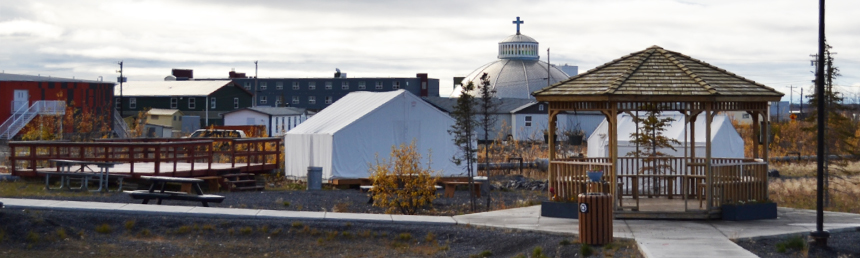
The Town of Inuvik's
history is quite short but it's not without excitement. The
first European to visit Inuvik was Sir Alexander Mackenzie
who stayed here in July 1789 on his epic journey down the river
that bears his name. This area traditionally for the native
people was really no-mans land between the Inuit (Eskimo) to
the north and the Dene (Indian) to the south. Only the odd
trapper ever visited the site of Inuvik. During the mid 1950's
the government of Canada felt there was a need for an administrative
center in the Western Arctic. Aklavik, the traditional center
was subject to flooding and erosion, in fact experts of the
day felt Aklavik would be washed into the Mackenzie before
too long. As well there was insufficient space for the needed
expansion. Consequently a search for a new site was launched.
In 1954, the first
survey teams flew to the Mackenzie Delta, looking for the best
site for the future, but unnamed town. A number of potential
sites were identified with this location being referred to
as East Three. The site was on a navigable river with access
to wood, gravel, a good, clean water supply and enough flat
land for a major airport. Moreover, the site had plenty of
room for expansion and definitely with no flood concerns. The
East Three site was selected and in hindsight the choice was
a good one.
The decision to build
Inuvik was not taken lightly by the Government of Canada, the
Department of Northern Affairs and Northern Resources was the
lead agent with assistance from the National Research Council,
Mines and Technical Surveys, Public Works, Transport, and National
Health and Welfare.
The planning and construction
of Inuvik was completely new. A venture like this had never
been tried in Canada thus every stage of the development became
a pilot study, an experiment, a new experience. Building a
town from scratch, on the permafrost, in the Arctic was a major
undertaking.
The site was chosen
in November 1954 and construction began in 1955 with completion
scheduled for 1961 or 1962. Construction was not an easy task.
The presence of permafrost meant building had to be on piles,
and above ground utilidors for water and sewer were needed.
As you walk around town you'll notice little shed like structures
running between buildings. These are utilidors.
There are two basic
types of utilidors although there are a number of variations
in construction materials. Some are made of wood, others of
steel and aluminum. The two types are those that have the water
and sewage lines and the high temperature heating system. The
other carries only the water and sewage lines. The utilidors
with the heating system use the heat lost to keep the water
running. In the utilidor with only water and sewage lines,
the hot water is heated and the cold water line runs beside
the hot water line using the heat to keep the water running
even at the coldest temperatures. The lines from the main utilidor
to each house are called utilidettes.
To give you some idea
of the complexity of building Inuvik consider that every building,
every road, every structure, the entire airport, everything
had to be either on piles or on a three foot gravel pad. The
runway at the airport is 6000 feet long and its entire length
including the taxiways are on a gravel pad, in some areas the
pad is 6 feet thick.
The cost of building
Inuvik, no one really knows. Although there rough estimates
that the cost to replace Inuvik today would cost anywhere from
$600 million to $900 million. The airport alone would cost
$50 million.
In the area where
Inuvik is built there is a lot of ice lenses. This is frozen
groundwater. In some places where the water has collected there
is pure ice. Blue ice. This is the reason the book about Inuvik
is called "On Blue Ice", we really built on blue
ice. If the ground gets heated and the ice melts there is no
structural support and the land will collapse. This can be
quite dramatic. A few years ago a fifty foot wide section of
road beside the sewage lagoon suddenly dropped about 25 feet
as the ice dense beneath was heated by the lagoon and the ice
melted, down went the road. The permafrost must be protected.
Nineteen fifty five
saw the building of the airstrip, wharf, storage warehouses
and camp buildings. By 1956 the site had begun to take shape.
Hundreds of piles were floated to the site and rammed home
with pile-drivers. In 1958 the power plant was installed.
In 1958 there were
a total of 21 streets in the various stages of construction.
Twelve streets, namely Distributor Street, the street the Arctic
College is on, Water Street, Mackenzie Road, the main street
of town, Mackenzie Square, Council Crescent, Franklin Road,
Millen Street, Firth Street, Reliance Street, Union Street,
Bompass Street and Breyant Street had buildings and were named.
Three streets, Kingmingya Road, Camsell Place and Spruce Hill
Drive had buildings but were named later. Six streets were
planned but construction had not been completed.
On July 18, 1958 Inuvik,
which means "Place of Man" in Inuvialuktun, officially
began by proclamation of the 15th session of the Council of
NWT Inuvik was the first planned town North of the Arctic Circle.
Inuvik as stated on the Town Monument, dedicated by the Rt.
Hon. John Diefenbaker, was created as a model community to
provided " the normal facilities of a Canadian town. It
was designed not only as a base for development and administration,
but as a centre to bring education, medical care and new opportunity
to the people of the Western Arctic."
Construction continued
with the building of the school in 1959, and the hospital,
office buildings and staff housing in 1960. The RCMP, CPC,
NCPC, Transport, National Defense, National Health and Welfare,
Citizenship and Immigration all has personnel living in Inuvik.
Many of the first houses built were cabins 16 ft by 32 ft and
because they contained 512 sq. ft. they became known as 512's.
During the early days
the community grew rapidly as Inuvialuit, Dene and Metis from
the Delta/Coast region and people from southern Canada moved
to Inuvik, creating a unique three culture community. On April
1, 1967 Inuvik was incorporated as the Village of Inuvik. Mr.
Sid Hancock was the first Reeve. Inuvik was the first incorporated
municipality North of the Arctic Circle.
Oil was discovered
in 1970 with natural gas being found in 1971 in the Mackenzie
Delta. These discoveries lead to further expansion of Inuvik.
The major oil companies established offices in our town and
the service sector for the oil patch rapidly expanded. Scientific
and environmental research in the area also expanded and the
Federal Government opened a scientific research laboratory
in Inuvik.
By 1970, Inuvik had
grown-up and in January 1970 became Canada's first and only
Town north of the Arctic Circle. The first Mayor was Richard
Hill. During the early 1970 Inuvik was a flourish of activity.
Buildings were being constructed, subdivision were established
all in the anticipation of the production of oil and gas from
the Delta. However things came to thundering crash in 1977
as a result of a 10 year moratorium recommended by Justice
Berger. Inuvik quickly learned what the term boom-bust means.
The downturn was halted and by 1980 with the renewed interest
in oil offshore the town started to grow again.
This renewed growth
was short-lived. In May 1985 the Government of Canada announced
that they were closing the Canadian Forces base in Inuvik.
The base was staffed by 267 personnel and at that time was
the largest single military installation in the North. The
closing of the base meant that about 700 people left town.
The Town felt that the military has made a mistake. Inuvik
is in a very strategic location. If you look on a map you can
see that Inuvik is on the Northwest entrance into North America
and the western entrance to the Northwest Passage. We lobbied
the military and the politicians pointing out the value of
Inuvik. As a result Inuvik was named as a Forward Operating
Location for the F18's and we are the resupply base for the
western portion of the North Warning System.
Then in 1986 the second
blow hit. The collapse of the price of oil. The oil companies
activities almost stopped. Fortunately the Mackenzie Delta/Beaufort
Sea is rich in both oil and natural gas. With the uncertainty
in oil, attention has shifted to natural gas. Earlier this
year Esso, Shell and Gulf made an application to the National
Energy Board to export natural gas from the Mackenzie Delta
to the United States. Hearings have been held and we are now
waiting to hear the results.
It is not all doom
and gloom. Today Inuvik is still the regional government centre
and the transportation hub of the Western Arctic. The completion
of the Dempster Highway in 1979 opened Inuvik and the Western
Arctic to the people of the world. Tourism is one of the growth
industries in Inuvik now. The future expansion of Inuvik although
hinges on the production of oil and gas from the Beaufort.
When this happens Inuvik is predicted to grow to 7000 or double
the size.
The Town of Inuvik
is an incorporated municipality with a population of 3389 and
is similar in operation to Town's in other parts of Canada.